Lotus AI
AI-supported communication platform designed to improve clinical handoffs and urgent communication.

In collaboration with
WIX, Base44 and Mount
Sinai Hospital
Tools
Base44, ChatGPT, Perplexity, Figma
Live Prototype
Role
Product Designer
research & design lead
Context
AI Product Sprint
Reichman University
Timeline
6 weeks
Sept 2025
The challenge
In hospitals, the most dangerous moment is the handoff.
Critical information often breaks down during shift changes, transfers, and emergencies, scattered across EHRs, chat, calls, notes, and verbal updates.
01
Fragmented systems
Information lives in EHRs, secure chat, phones, paper notes, and hallway updates — none talking to each other.
02
No urgency tiering
An emergency and a routine update arrive in the same inbox, with the same notification, in the same tone of voice.
03
Hierarchy & location ambiguity
Nurses can't reach attendings directly. Specialists can't be located. The result is delay.
Research
Understanding how clinicians communicate under pressure.
We investigated where communication breaks down, how urgency is communicated, and what clinicians do when existing tools fail.

5
Academic papers
Healthcare communication, ISBAR handoffs, AI in acute care
3
Real interviews
Pediatric PA (ICU), anesthesiology resident, PICU nurse
4
Synthetic personas
GPT-generated to stress-test edge cases and refine protocols
7
Competitors mapped
TigerConnect, Spok, Vocera, Hyro, Trialynx and more
Key findings
What we heard from clinicians.
Four key findings emerged from the interviews and shaped the product direction.
Finding 01
Urgent and routine information look the same.
No shared way to mark a mCritical updates compete with routine messages and are easily missed.essage as critical. A code-blue and a “FYI lunch is here” land in the same chat thread.
“There’s no way to stratify what type of communication is needed.”
— Anesthesiology resident
Finding 02
Information gets buried.
Long notes and overloaded inboxes make essential details difficult to identify quickly.
“I would have a hundred messages — things fall through the cracks.”
— Pediatric PA
Finding 03
Communication depends on finding the right person.
Location uncertainty and organizational hierarchy create delays and unnecessary handoffs.
“I’m reaching out to their resident to then reach out to them — we’re playing telephone.”
— Anesthesiology resident
Finding 04
Clinicians want AI support, not AI decision-making.
AI was welcomed for summarizing, prioritizing, and coordinating information—but not for replacing clinical judgment.
“I like AI and I’m not scared of it — if it’s helpful, I’m open to using it.”
— Anesthesiology resident


Competitive landscape
A clear gap on the map.
Existing tools tended to be either medically focused but reactive, or intelligent but disconnected from clinical workflows. LOTUS explored the space between them.
Scenarios
Three moments the product needed to solve.
Based on interviews and contextual research, we identified three recurring moments where communication breaks down.

Scenario 01
Urgent coordination
Dr. Alex Nguyen
ICU Physician
PROBLEM
Urgent requests arrive through disconnected systems with no clear priority or ownership.
CRITICAL MOMENT
A lab result requires immediate action, but finding the right clinician creates delay.
“Half my shift is spent chasing the right person instead of treating the patient.”

Scenario 02
Routine handoff
Maria Lopez
ICU Nurse
PROBLEM
Important patient updates are scattered across documentation, chat, and verbal communication.
CRITICAL MOMENT
Maria needs to transfer a patient’s status without losing critical details.
“I’ll chart it all — but unless I catch the right person at the right moment, I can’t be sure they’ll see what matters.”
Scenario 03
Hands-free emergency
Maria Lopez
ICU Nurse
PROBLEM
During bedside emergencies, clinicians may not be able to stop, search, type, or call.
CRITICAL MOMENT
Maria needs immediate assistance while both hands are occupied with the patient.
“During a critical bleed, I’m holding pressure with both hands — I have no way to call for help without leaving the bedside.”


Prototype
LOTUS brings messaging, handoffs, prioritization, and voice-based escalation into one clinical communication layer.
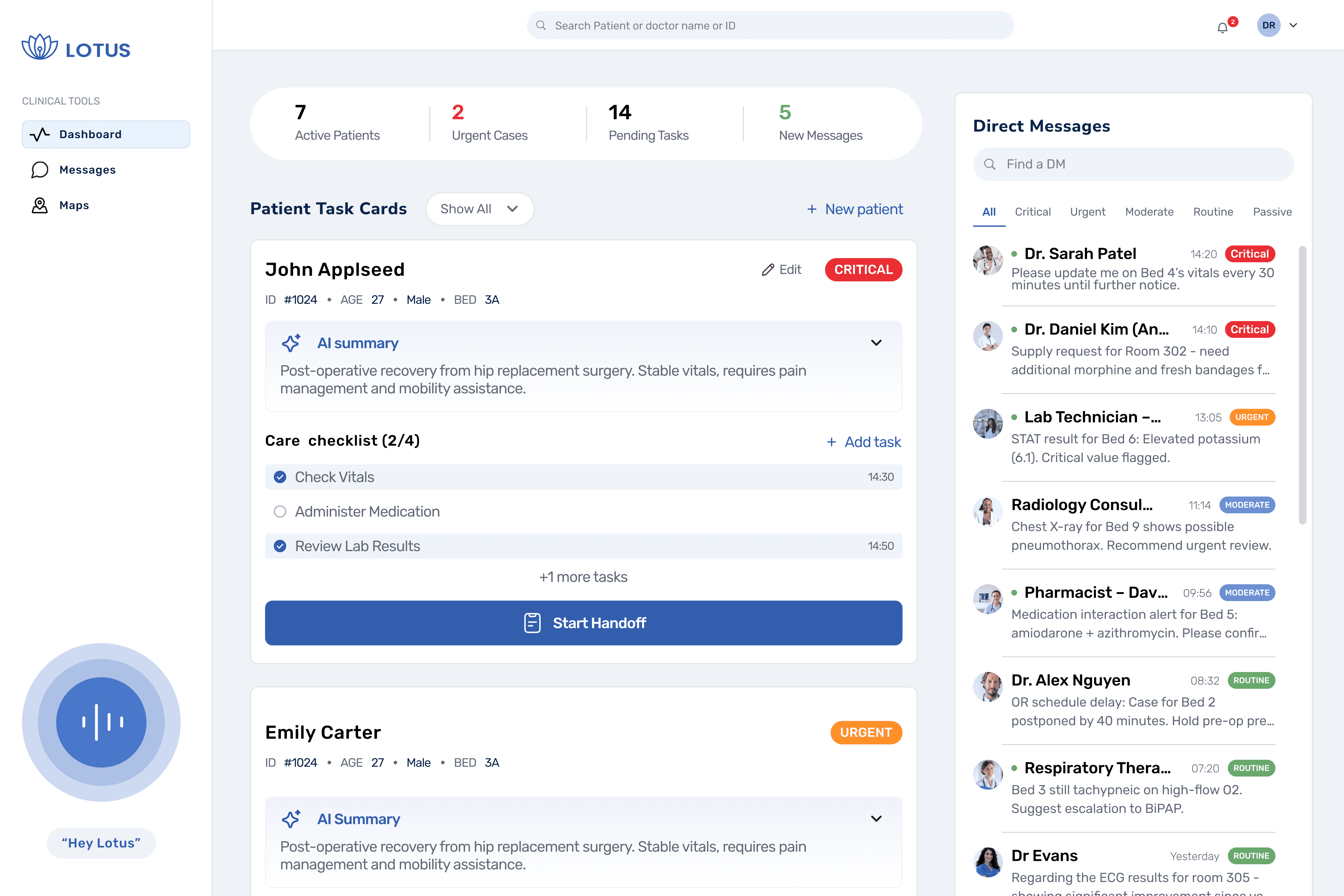

Urgency-aware messaging
Critical, urgent, moderate, and routine updates are clearly differentiated, helping clinicians identify what needs attention first.

Structured handoffs
LOTUS turns scattered patient updates into a structured handoff with patient status, urgency, next tasks, and ownership.

Hands-free escalation
“Hey Lotus” allows clinicians to summarize, send, or escalate critical information without stopping bedside care.
