AI-Powered
Playlist Creator
Bridging the gap between literary atmosphere and auditory
experience through semantic AI mapping.

Tools
Cursor
Base44
Google Books API Key
OpenAI API Key
API Keys
Google Books
OpenAI
Duration
4 Weeks
year
2026
Role
Overview
AI Playlist Creator is a Spotify-inspired web app that turns books into personalized music playlists. It was designed as an AI-assisted product experience that helps readers generate soundtracks based on a book’s mood, themes, and reading context through a structured and intuitive flow.
The Problem
Readers often want a soundtrack that reflects a book’s mood and themes, but creating one manually is time-consuming and subjective.
Pain Points
High Cognitive Load
Translating a book’s mood into music requires time and subjective decision-making.
Limited Context Awareness
Music platforms don’t consider how a book’s mood changes throughout the story.
The Solution
Designed a structured, Spotify-inspired experience that reduces cognitive load and enables context-aware playlist creation by guiding users from book selection to AI-generated results.
Guided Creation Flow
Instead of relying on open-ended input, the experience guides users through a clear sequence:
Step 01
Select a book
Choose a use case
(Optional) Pick a chapter
Generate playlist
This makes the process more intuitive while giving the system clearer inputs to work with.
Context as Input
The system uses meaningful context to improve results:
Reading status
Currently reading or finished.
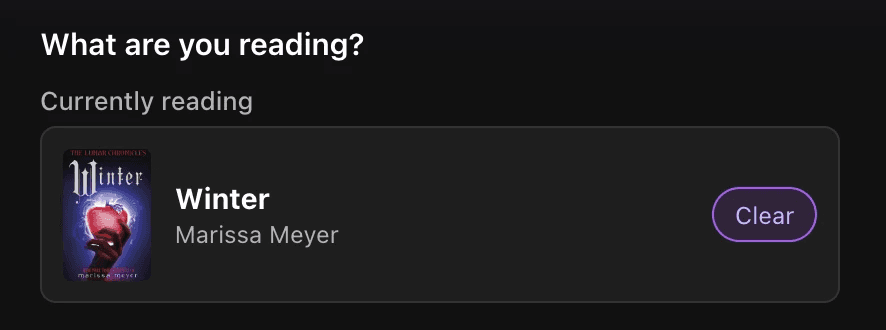
Use case
Accompany reading or extend the experience.

Chapter Selection
Focus on a specific chapter or moment.

User Journey
Users can begin from their bookshelf or search for a new book. Whether currently reading or recently finished, each entry point leads to the same guided playlist-generation flow.
Starting from Your Favorites
Quick access to saved books allows users to begin playlist creation instantly using familiar titles.
AI Strategy & Integration
AI was designed as a core part of the experience—not as a standalone feature.
1
Book analysis
Identifying themes, tone, and emotional arc.
2
Playlist generation
Translating the analysis into music recommendations.
Process
Book input
Outcome
The two-step approach produced more relevant and consistent results than a single prompt.
Designing for trust and transparency
Each generated song includes a collapsable short explanation of why it fits the book. This transforms AI output from a “black box” into something users can:
Understand
Evaluate
Trust

System Inputs & Data Sources
The experience combines reading data, book metadata, AI generation, and local storage to create personalized playlists.
Storygraph CSV
Provides reading list data and powers the personal shelf experience.
Google Books API
Supports book search, metadata enrichment, and fallback cover sources.
AI Models
Generate 10-song playlists, explanations, and visual cover concepts.
localStorage
Stores history, saved playlists, and favorites in the browser.
Guardrails & Reliability
Structured inputs kept the results focused and consistent. Backup content helped maintain the experience when external services were unavailable.
Flexible book search was combined with structured inputs for reading status, use case, and chapter. This gave users a clearer flow and helped the AI generate more relevant playlists.
Quick Pick reduces friction by letting users select a favorite book instantly.
Iterations & Evolution
The concept evolved from broad playlist customization to a simpler, book-focused flow with more relevant results.
Version 1 — Open Inputs
Users created playlists using mood, activity, and inspiration.

Version 2 — Story Structure
Songs were grouped into beginning, middle, and end to follow the story.

VERSION 3 — FINAL BOOK-CENTERED FLOW
The final version used reading status, book selection, and use case to create a simpler, more relevant experience.

What Worked
Two-Step AI Pipeline
Separating book analysis from playlist generation improved consistency.
Clear Recommendations
Short explanations helped users understand why each song was selected.
Familiar Experience
Spotify-inspired patterns made the product easy to use.
Fallback Logic
Backup content kept the experience running when services failed.
Challenges
Storage Limits
Local storage restricted how much data could be saved.
Inconsistent Covers
AI-generated covers did not always feel visually consistent.
No Playback Integration
Users could receive recommendations but not play them directly.
AI Tool Precision
Accurate UI results required detailed prompts and repeated refinement.
Next Steps
Playback Integration
Enable direct Spotify playback to make playlists actionable.
Refinement Controls
Allow simple adjustments like mood or artist to personalize results.
Transparency
Show how playlists match the book to improve trust.